Hydrogen is one of the low carbon solutions that will be critical for the UK’s transition to net zero.
Within our wider plans to deliver low carbon gas solutions more broadly, hydrogen will be critical for the UK’s transition to net zero, to keep the energy system in balance as its dependence on weather dependent renewables increases and to help tackle the emissions from hard to decarbonise sectors.
For the UK to meet its 2050 net zero commitment and government’s clean energy mission alongside the industrial strategy, low carbon hydrogen solutions must be rapidly scaled through the next decade.
However, hydrogen needs a whole system approach. Production of low carbon hydrogen cannot be scaled without a market for clean hydrogen. Technologies for hydrogen use (like hydrogen to power) will not be developed and deployed without a source of hydrogen, and large-scale projects cannot come forward without both a hydrogen network and storage assets. Therefore Centrica’s hydrogen projects are focused initially on building out projects to deliver such an ecosystem, focused around the Humber.
Transforming the Humber Region
The Humber supports 360,000 jobs, contributes £18bn to the UK economy each year and sits at the heart of the UK energy system infrastructure. It is also home to critical infrastructure that underpins national energy security and decarbonisation.
This concentration of energy infrastructure has also made the Humber a hub for energy intensive industries, contributing over 20 million tonnes of CO2 annually. With the right investment and policy support, the Humber can lead the UK in scaling low-carbon hydrogen and carbon capture – technologies vital to achieving net zero.
Prioritising the Humber’s transition will reduce emissions, secure energy resilience, and support growth by unlocking thousands of high quality, well-paid jobs, making it a cornerstone of the UK’s clean energy future.
Centrica’s Hydrogen Vision
Powering the UK’s clean energy future
Centrica is advancing a bold, integrated hydrogen strategy in the Humber, focusing on four nationally significant pillars:
Hydrogen Production
Establishing large-scale, low carbon hydrogen production at Easington using both blue and green pathways to support industrial decarbonisation and system-balancing.
Hydrogen Transport
Developing the Humber Hydrogen Pipeline to connect production, storage and end-use sectors - unlocking regional decarbonisation and enabling the national network build out.
Hydrogen Storage
Repurposing the Rough gas field into one of the UK's first large-scale hydrogen storage facilities providing essential system flexibility and seasonal resilience
Hydrogen Power
Demonstrating the potential of clean, dispatchable hydrogen - fired power at Brigg Peaking Plant to support grid stability.
Our Projects in the Humber
With plans to invest £2 billion transforming Rough into one of the world’s largest hydrogen storage facilities, we're driving a bold vision for the region’s future. This transformation will not only secure the UK’s energy supply but also unlock thousands of green jobs and support industrial decarbonisation. From powering homes to shaping careers, the Humber’s potential is vast but realising it requires strategic government support.
Find out more about how we’re transforming the Humber into a hydrogen powerhouse and hear directly from the people shaping its future.
Click on the interactive map below to discover more about each initiative and see how they’re developing over time.
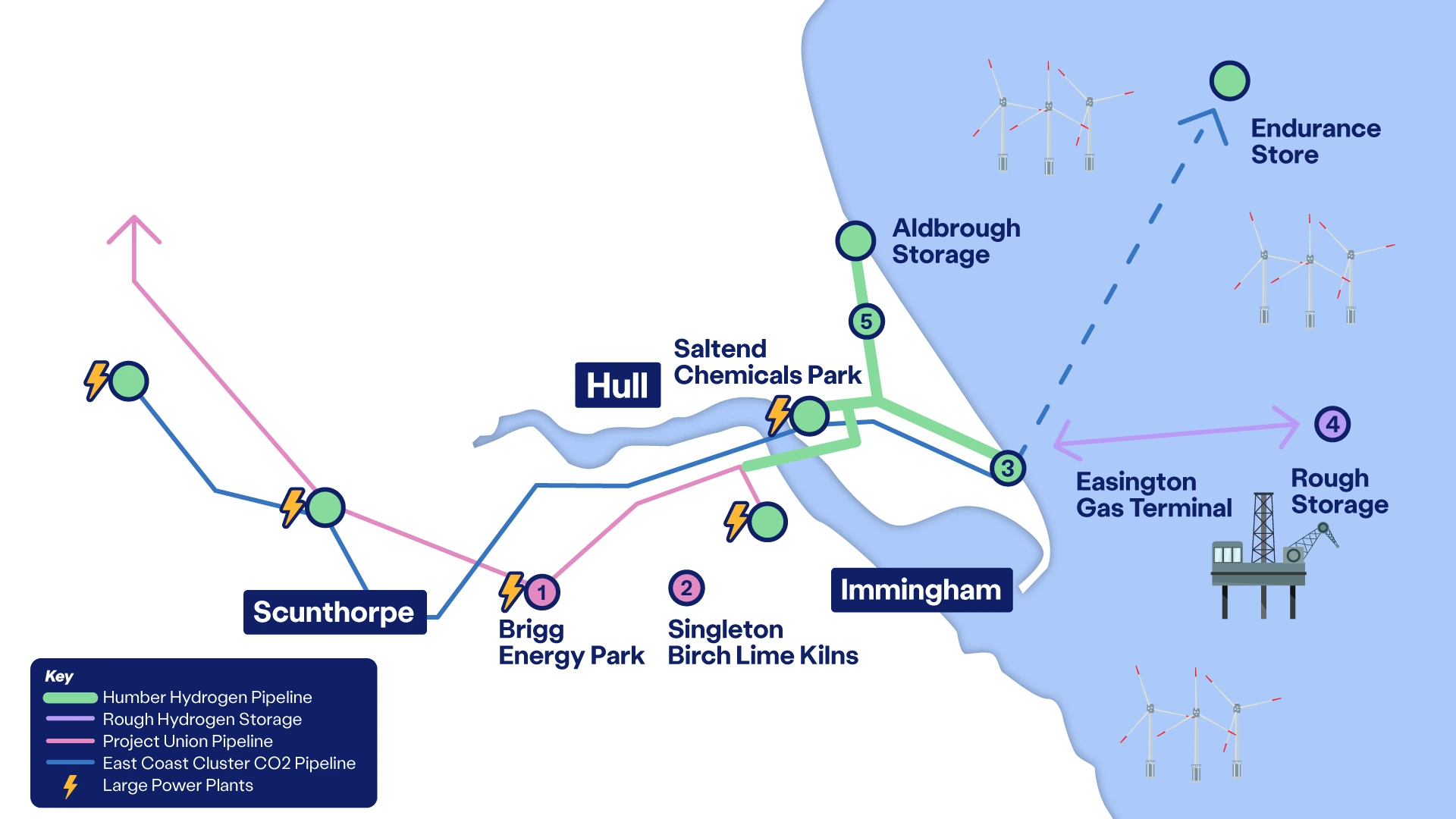
1. Brigg Energy Park

HIIROC Hydrogen to Power (H2P) Project
Centrica’s Brigg Gas Peaker provides flexible electricity during peak demand or low renewable output. In a UK-first trial, low-carbon hydrogen from HiiROC’s pilot plant was blended into the fuel mix, rising from 3% to 20%, to explore hydrogen’s role in power generation. The project is part-funded by the Net Zero Technology Centre. Read the full story here.
Hydrogen Trial Milestone: First Blend into UK’s National Transmission System
Centrica and National Gas successfully trialled a 2% green hydrogen blend in the National Transmission System, powering Brigg Power Station and feeding electricity into the grid. This UK-first proves hydrogen blending is technically and operationally viable, supporting flexible power generation and the UK’s Clean Power goals for 2030. Read the full story here.
2. Singleton Birch
Decarbonising lime production at Singleton Birch
This early project for a 10MW electrolyser at the Melton Ross Quarries to blend hydrogen into the natural gas-fired kilns producing lime, a vital foundation industry key for making batteries, steel, as well as being used in construction, agriculture and wastewater treatment. The project will allow Centrica to build early skills and project knowledge, key for scale-up.
3. H2H Easington

H2H Easington and transitioning the gas terminal at Easington.
A significant project, it has been independently calculated by the University of Hull[1] that this project could add £1.025bn to the economy and 2000+ jobs over 35 years
4. Rough Storage

Redeveloping Rough Energy Storage
Rough sits in the heart of the Humber. It currently provides half of the UK’s long duration storage capacity. Storage will remain key to manage the energy system, increasingly reliant on weather dependent renewables. Longer term, it is envisaged that Rough could become a more responsive, seasonal storage asset, able to store larger volumes of hydrogen ( Up to 16TWh equivalent - 80,000 grid sized batteries) to meet seasonal energy needs during longer cold, windless spells during winter.
This redevelopment can create over 4,000 transient jobs across the supply chain and a further 100 full-time jobs post-completion.
5. Easington, Aldbrough and Saltend

Humber Hydrogen Pipeline (HHP)
HHP is being developed by Equinor in partnership with both Centrica and SSE to create a network of producers and users across Holderness in East Yorkshire, linked by 45km of dedicated pipelines. The project links Centrica’s large scale hydrogen production at H2H Easington (with Equinor) to H2H Saltend (Equinor), including energy generation and key users at the Saltend Chemicals Park, with Aldbrough hydrogen storage and pathfinder project (Equinor and SSE). Humber Hydrogen Pipeline is a key infrastructure asset to unlock hydrogen cost reductions and drive swift scale up of the system, focused around government’s priority hydrogen users.
The network will include proposals for a Humber crossing and has been designed to enable connection into the wider Project Union & East Coast Hydrogen infrastructure. It could also work alongside the proposed East Coast Cluster CO2 pipeline to deliver a key regional hydrogen eco-system.
Making hydrogen happen
Redditch Peaking Plant
Construction is complete on Centrica’s new 20MW hydrogen-blend-ready gas-fired peaking plant in Worcestershire, transforming the previously decommissioned Redditch power plant.
The plant is designed to support times of high or peak demand for electricity.
The Redditch peaking plant forms part of Centrica’s plans to invest between £600m - £800m a year until 2028 in renewable generation, security of supply, and its customers, including building out a portfolio of flexible energy assets.
Read more here.

Whitegate Combined Cycle Gas Turbine
Alongside Mitsubishi Power Europe Limited, we’re exploring the development, construction, and operation of Europe's first-ever ammonia-fired power generation facility at Whitegate Combined Cycle Gas Turbine power station in Cork.
The utilisation of low carbon ammonia as a clean and sustainable fuel source for power generation has the potential to provide security of supply while reducing greenhouse gas emissions.
We hope to be able to show how hydrogen could be stored and transported as low carbon ammonia, delivering cleaner energy for customers at the point of use.
Find out more here

Hydrogen | What we're doing to help kickstart the hydrogen economy
Latest stories

Case study
Powering the energy transition: how early careers are shaping the Humber’s future
Hydrogen
Our People

Company news
Leading energy companies unite in bid to create Britain’s first hydrogen network in the Humber
Hydrogen
Net Zero

Company news
Brigg Breakthrough: Hydrogen Blending Powers Up UK’s Net Zero Ambitions
Hydrogen
Infrastructure

Company news
Funding awarded for study on hydrogen storage potential in North Yorkshire
Hydrogen
ESG

Company news
Hydrogen Milestone: UK’s First Hydrogen-to-Power Trial at Brigg Energy Park
Hydrogen
Net Zero

Case study
Powering the Humber energy revolution
Hydrogen
Net Zero