
For the fifth year running, we've carried out a comprehensive survey of the UK public exploring attitudes towards Net Zero at home.
And the 2025 Hive Home Report reveals a clear message from over 4,000 households across the UK - financial benefit is the driving force behind home energy decisions.
The key findings are:
- Investing in eco-tech makes financial common sense. Households say they’ll invest if it helps save money – and those who already have are seeing results. Early adopters report lower energy bills, greater control, and a reassuring sense they’re doing their bit for the planet.
- Eco-tech feels out of reach for many, but it doesn’t have to be. People often overestimate installation costs or assume their home isn’t suitable. Many are also unaware of grants and schemes that spread the cost into affordable monthly instalments.
- Many eco-tech owners aren’t maximising the full financial benefits of their devices. Although they generally have lower energy bills, up to 36% don’t know about special energy tariffs for heat pumps, EV chargers and solar panels.
- Solar panels are winning the eco-tech race. As the longest-established device, costs have dropped significantly and users are overwhelmingly positive about their experience.
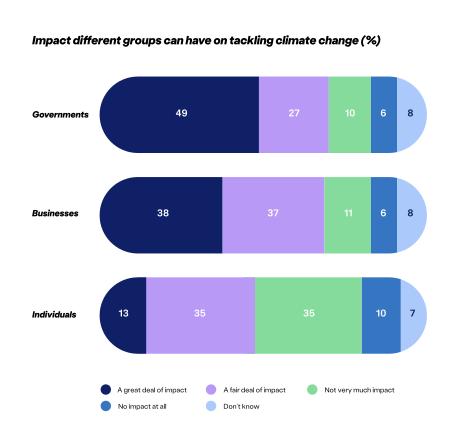
- People want to see more climate action from governments and businesses. But they’re unsure how to make a meaningful personal impact. While it’s not the main driver for investment, early adopters say their actions do make a difference.

“The confidence to adopt energy-saving tech comes down to good, old fashioned financial common sense. Households will invest if it helps them save - and early adopters say it does.”
Tom Pakenham, Director at Hive
Below is a graph that highlights the impact that different groups can have on climate change. The public are certain governments can have a large impact on tackling climate change.
By breaking down misconceptions, increasing understanding of how much support is available, and educating people on the real benefits of eco-tech, we will see more households inspired to make the switch. Every decision at home adds up, and together we can power a greener future where clean energy is the everyday choice.
The actions the eco-tech industry and policymakers need to take is clear.
To shift the dial, homeowners need:

Clearer information on costs and support
Many homeowners overestimate installation costs and aren’t aware of the financial support that’s available to help reduce upfront payments. Where grants and schemes have been introduced, uptake of solar panels and heat pumps has risen sharply – proof that financial support is a powerful driver of adoption. Offering finance options at key purchase moments such as moving home or undertaking renovations, alongside schemes like Sunsave’s no-upfront-cost solar subscription, will help make eco-tech more financially accessible. Better education and clearer signposting to these grants, flexible payment options and the actual costs of installation will give more homeowners the confidence to take the leap.

Proof of real savings
To overcome scepticism about eco-tech’s ability to cut energy bills, proof of real-world savings needs to be shared more widely. While prices are expected to fall further as adoption increases, solar panels are a great example of how eco-tech already delivers strong returns: 69% of owners report lower bills. Other eco-technologies are also proving their value, with for example, 56% of EV charger owners reporting reduced spending. Greater awareness of these savings, alongside education on special energy tariffs offering access to further savings, will go a long way to convincing more households that eco-tech is a worthwhile investment.

Clarity on home suitability
Up to 37% of people believe their homes either aren’t fit for eco-tech or the devices would be too difficult to install. In reality, the majority of homes are suitable: 66% of UK homes can have solar panels fitted, 55% are suitable for heat pumps, and 67% could host EV chargers. Some home energy management products like smart thermostats suitable for everyone. Nonetheless, misconceptions are holding people back – yet the potential for growth is huge.

A stronger sense of personal impact
Many people see climate change as a job for governments and businesses, even thought 20% of UK emissions come directly from homes and a further 15-20% from private cars. While cost and savings are the key messages needed to drive investment in eco-tech, we need to help homeowners understand that saving energy saves both money and carbon. This would empower more people to play their part in driving change, and show the connection between personal benefit and saving the planet.


